Few gardening skills are as satisfying — or as practical — as propagation. Creating new plants from ones you already own means you can grow your collection indefinitely without spending a cent.
Why Bother Learning to Propagate?
The Real Value of Propagation
For anyone dreaming of oversized houseplants, propagation is worth taking seriously: given enough time and the right technique, a modest cutting can become a genuine statement piece. Whether you’re a beginner nursing a single pothos or an enthusiast with every windowsill spoken for, a handful of core methods is all it takes to unlock truly endless growth.
The appeal comes down to three things: it saves money, it preserves rare or sentimental varieties that might be impossible to replace, and it produces results far faster than growing from seed. There’s also a less tangible benefit — the hands-on process gives you a much deeper feel for how plants actually grow, root, and respond to care.
Take a common pothos as an example. A single trailing stem can yield three or four new plants within a matter of weeks, each one ready to pot up, pass along to a friend, or train into a larger specimen over time.
Key takeaway: Propagation gives beginners a sustainable, low-cost way to build a thriving collection from the ground up.
Tools and Preparation: Keep It Simple
You don’t need specialized equipment to get started. The basics cover most situations:
- Sharp, clean scissors or pruning shears
- Small pots with drainage holes
- A suitable potting mix (perlite-heavy for cuttings; standard mix for divisions)
- Glass jars for water propagation
- Rooting hormone — optional, but it meaningfully improves success rates by encouraging root development at cut surfaces
Before taking any cutting, wipe your tools down with rubbing alcohol to avoid transmitting disease between plants. It’s also worth being selective about your source material: always choose a healthy, actively growing “mother” plant. Stressed or dormant specimens root poorly and aren’t worth the effort.
Method 1: Stem Cuttings in Water or Soil
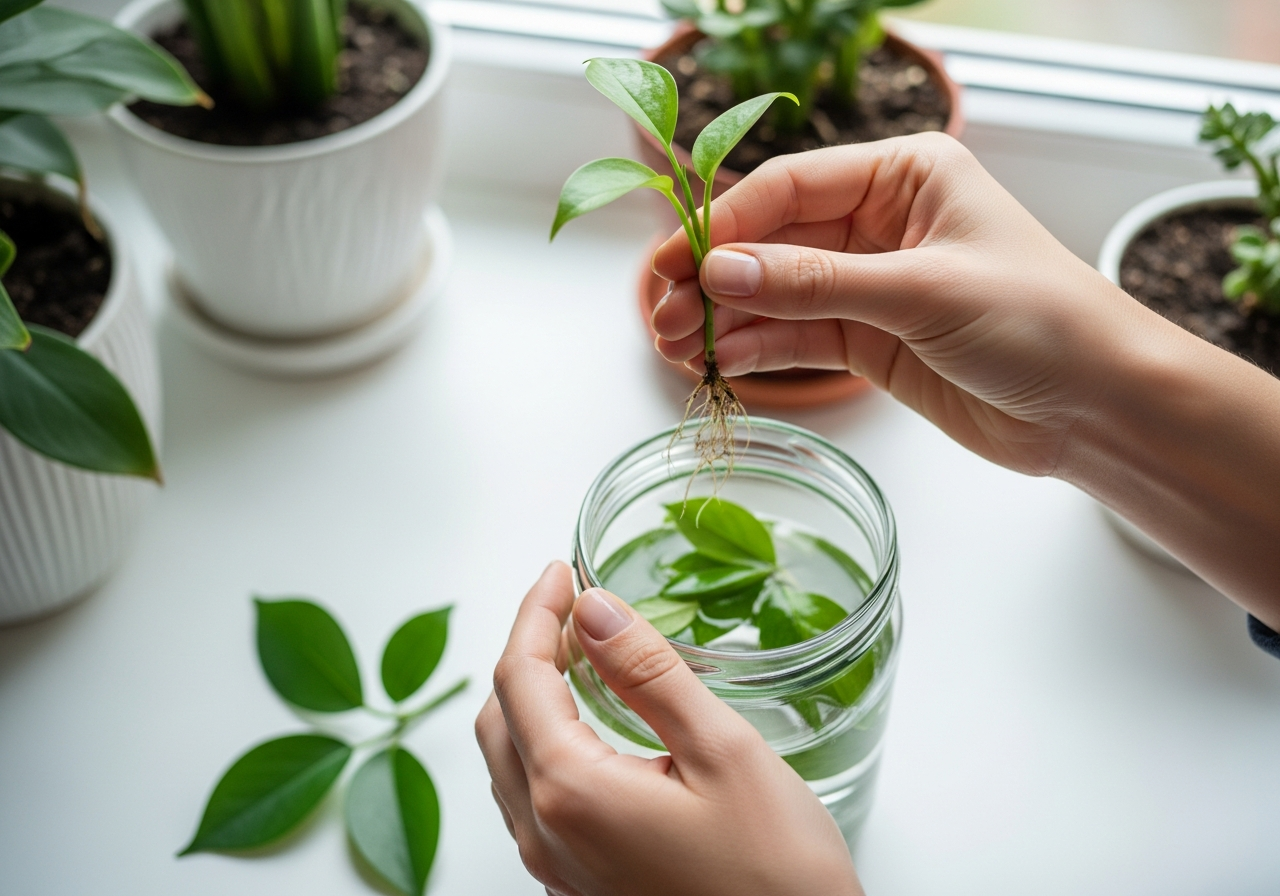
Stem cuttings are the go-to approach for pothos, philodendron, and monstera. The key is finding a node — the small bump or joint along the stem where roots will eventually emerge.
Water method: Cut just below a node, strip the lower leaves, and submerge the node in a jar of room-temperature water. Change the water every few days to keep it fresh, and transplant to soil once roots reach 2–3 inches long.
Soil method: Dip the cut end in rooting hormone, press it into moist potting mix, and tent a clear plastic bag over the cutting to hold in humidity.
Water vs. soil — a quick comparison:
– Water: You can watch root progress in real time, but transplant shock is a real risk
– Soil: Roots form directly in their final environment, so there’s less disruption — though you won’t see much happening from the outside
If cuttings start looking leggy or pale, move them closer to a bright, indirect light source. Inadequate light is the single most common reason propagation stalls or fails entirely.
Method 2: Leaf Cuttings and Division
Succulents, snake plants, and African violets are well suited to leaf propagation. Cut a healthy leaf with its petiole intact, insert the base shallowly into moist soil, and keep it somewhere warm with light, regular misting.
For clumping plants — spider plants, peace lilies, and similar species — division is even more straightforward. During spring repotting, gently tease rooted offsets away from the parent plant and pot them up individually. Spring is the ideal window because plants are entering active growth and bounce back quickly. For the first few weeks, keep moisture consistent without letting the soil become waterlogged.
Method 3: Layering for Trailing and Woody Plants
Layering takes a different approach: instead of severing a stem before roots form, you encourage roots to develop while the stem stays connected to the parent plant. This dramatically reduces stress on the new cutting.
Simple layering works well for vines. Pin a stem node against a pot of moist soil while it’s still attached to the parent, wait for roots to establish, then sever and pot it separately.
Air layering is the better option for larger, woodier plants like dumbcane or schefflera. Wound the stem, pack damp sphagnum moss around the wound, and wrap it tightly with plastic film. Check weekly — once roots are clearly visible through the wrap, cut below the rooted section and pot the new plant.
[A step-by-step diagram of the air layering process would be a useful visual addition here.]
Troubleshooting: When Things Don’t Go to Plan
Even experienced propagators run into problems. Here are the most common issues and how to address them:
- Rotting stems or leaves: Cut back on watering and make sure drainage is adequate
- No roots after several weeks: Check light levels first, then consider applying rooting hormone
- Wilting cuttings: Boost humidity with a plastic tent or an oven bag draped loosely over the pot
- Yellowing leaves: Remove any foliage that’s submerged in water immediately — it will rot and foul the water
As a general rule, keep temperatures between 65–75°F and provide bright, indirect light. Getting those two conditions right resolves the vast majority of propagation problems before they even start.
Caring for New Plants After Rooting
Once roots have formed, new plants need a gradual transition to normal conditions. Rather than pulling the plastic cover off all at once, vent it a little more each day over several days to slowly acclimate the plant to ambient humidity. Hold off on fertilizing for the first month — young roots are surprisingly sensitive to concentrated nutrients, so start with a diluted, balanced feed when you do begin.
From there, repot into progressively larger containers as the plant fills out, and adjust its light exposure to encourage full, vigorous growth. The care you put in during these early weeks has an outsized effect on whether a small cutting eventually becomes a lush, healthy specimen.
Building a Propagation Practice That Sticks
Propagation is one of the most rewarding skills a plant lover can develop, and the range of methods means there’s an approach for almost every plant you’re likely to own. Stem cuttings suit fast-growing tropicals; leaf cuttings work beautifully with succulents and snake plants; division is perfect for clumping species; and layering handles the trickier, woodier plants that other methods struggle with.
The best way to build confidence is simply to begin. Take one cutting from a plant you already own this week, set it in water or soil, and pay attention to what happens. That single step is the start of a propagation practice that can fill your home with greenery — grown entirely by your own hands.