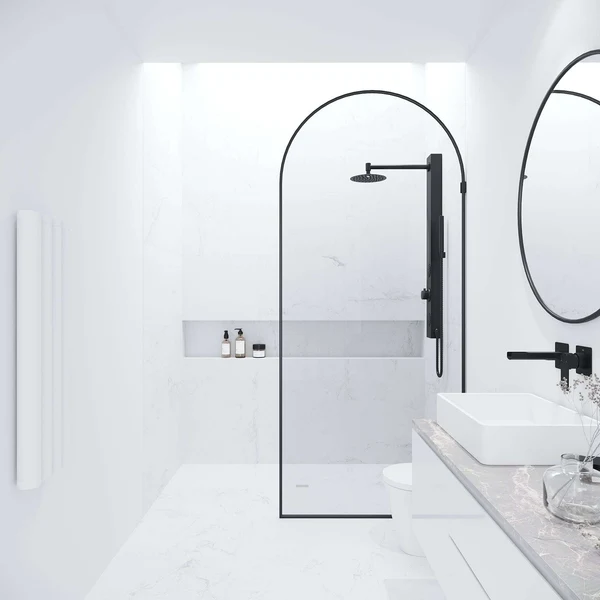
Walk into almost any newly renovated primary bathroom right now and there’s a good chance the shower isn’t boxed in anymore. No door swinging open on a hinge, no sliding track along the floor, sometimes not even a curb to step over. Just a single sheet of glass standing between the shower and the rest of the room. This is the open shower look, and it’s become one of the defining shifts in bathroom design over the last several years.
Quick answer: Fixed shower screens are stationary glass panels — rather than doors — used to contain water splash in curbless, walk-in, and open-concept bathroom layouts. They’re gaining popularity because they support the barrier-free, spa-like aesthetic homeowners are increasingly requesting, while remaining simpler to install and maintain than a full enclosure with moving hardware.
What’s Actually Driving This Shift
The move toward open, low-barrier showers isn’t just an aesthetic trend — it’s backed by measurable data on how homeowners are actually renovating. Recent industry bathroom trend research found that low-curb showers now appear in roughly half of renovation projects, with fully curbless designs continuing to climb year over year. Corner and walk-in configurations with minimal thresholds have become the default request rather than a specialty option reserved for accessibility-focused remodels.
There’s a practical thread running through this trend alongside the design one. A curbless, barrier-free shower is easier to enter for people at every stage of life, which matters more to homeowners now than it used to — many are explicitly planning bathrooms that will still work for them, or for aging family members, a decade from now. But the aesthetic appeal is doing just as much work. A shower without a boxed-in door reads as more spacious, lets tile and stone finishes flow uninterrupted from floor to wall, and avoids the visual clutter of a hinge, track, or frame breaking up the room.
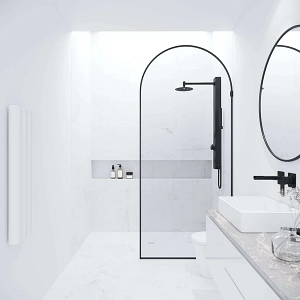
Where a Fixed Screen Fits Into This Layout
A fixed shower screen is simply a stationary glass panel, as opposed to a door that opens. It doesn’t slide, swing, or pivot — it just stands in place, containing splash while leaving the rest of the shower open. That makes it a natural fit for curbless and walk-in layouts, where a swinging or sliding door would either need floor clearance that doesn’t exist or feels unnecessary in a shower with no threshold to step over in the first place.
This is different from a full enclosure, which wraps the shower in glass on multiple sides with a functioning door as the entry point. A fixed screen is typically used for showers where the layout itself — an alcove, a corner, or a dedicated wet area — already contains most of the water, and the screen’s job is just to block splash along the one open side.
VIGO’s fixed shower screens collection illustrates the range available within this category. The panels come in framed and frameless styles, with glass finishes from clear to fluted and textured options for anyone who wants a bit of visual privacy without closing off the space or losing natural light. Because the panel doesn’t move, the mounting hardware and wall seal carry more of the functional weight than they do on a sliding or hinged door, which is worth paying attention to regardless of which brand or collection you’re considering.
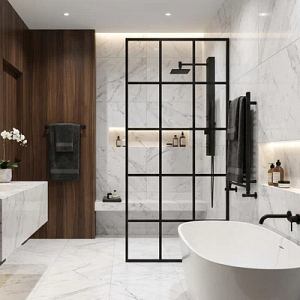
Design Considerations for a Fixed Screen Layout
A few things matter more with a fixed screen than they do with a traditional enclosure, since there’s no door to compensate for layout gaps.
Panel height and width need to fully cover the shower’s open side, since there’s no second panel or door to catch overspray at the edges. Floor slope and drain placement matter more too — a curbless or low-curb shower relies on a properly sloped floor and, often, a linear drain to keep water contained without a threshold doing that job. Glass texture is worth considering deliberately rather than defaulting to clear: fluted or textured glass can add privacy and visual interest while still allowing light through, which matters in a shower that’s meant to feel like part of the room rather than sealed off from it. And wall-mounting substrate matters more here than people expect, since the screen’s stability depends entirely on a secure connection to the wall rather than a floor-anchored frame.
Frequently Asked Questions
What’s the difference between a fixed shower screen and a shower door?
A fixed shower screen is a stationary glass panel that doesn’t open, used to contain splash in curbless or walk-in shower layouts. A shower door is a moving panel — sliding, hinged, or pivoting — that serves as the entry point into a fully enclosed shower.
Do curbless showers need a fixed screen?
Not always, but most curbless and walk-in showers use a fixed screen or partial glass panel to contain water splash on the open side of the shower, since there’s no curb to help keep water contained.
Is a fixed shower screen harder to maintain than a sliding door?
Generally no. Without a track, rollers, or hinges, there are fewer moving parts to clean or maintain, which is part of why fixed screens have become popular in low-maintenance, minimalist bathroom designs.
The Bigger Picture
The open shower trend isn’t a passing style choice — it reflects a genuine shift in how people want their bathrooms to function and feel, supported by renovation data that shows this preference growing rather than leveling off. A fixed glass screen is one of the more straightforward ways to execute that look, particularly in layouts where a full enclosure with a door would add complexity without adding much benefit. For anyone planning a bathroom renovation with this kind of open, spa-like feel in mind, it’s worth understanding where a fixed screen fits before defaulting to a traditional door-based enclosure out of habit.